NUR
"Usage defines the design. Not the other way around."
Product images are conceptual visualizations. Arabic text in images serves as illustration. Final products may differ.
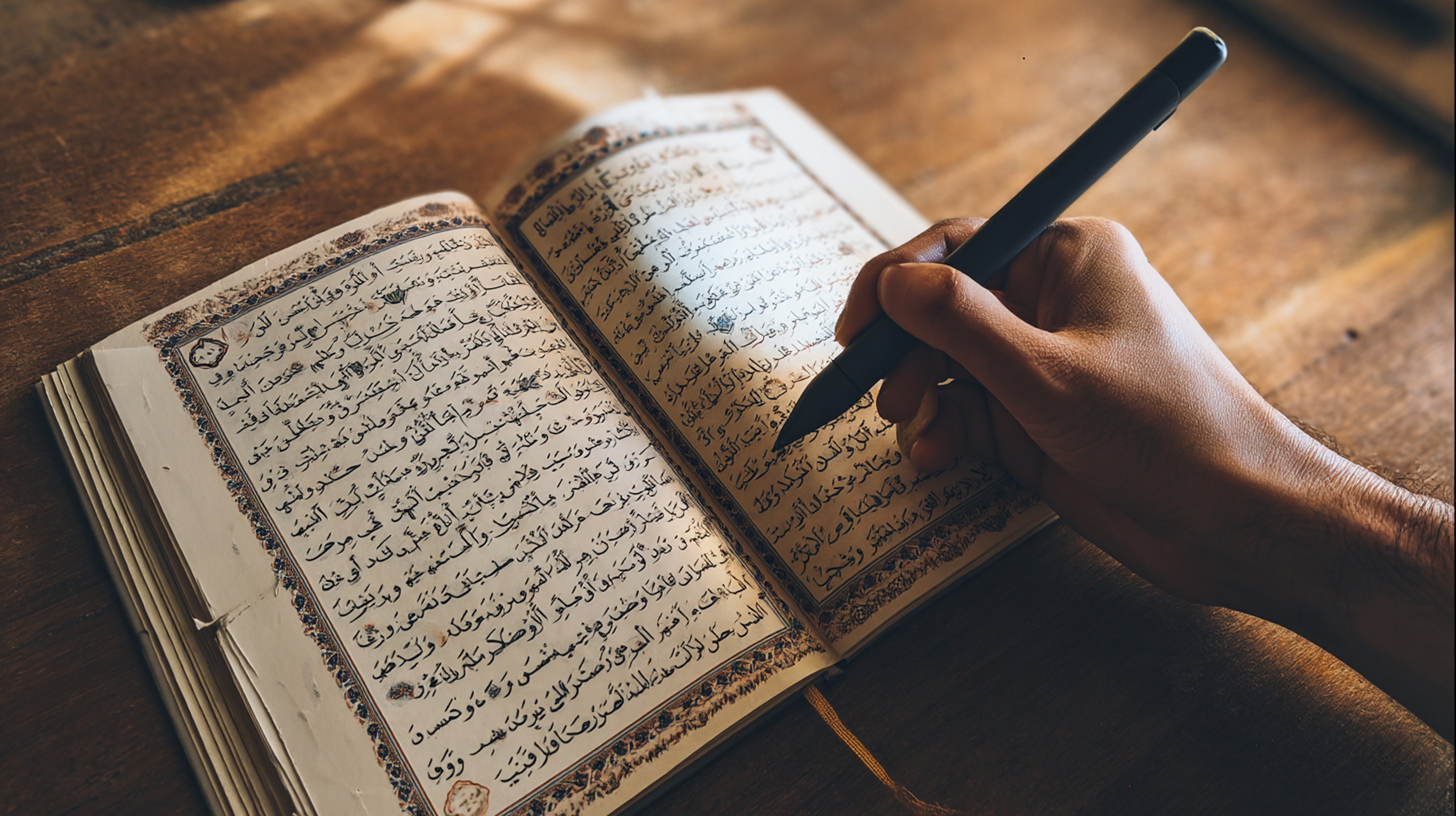
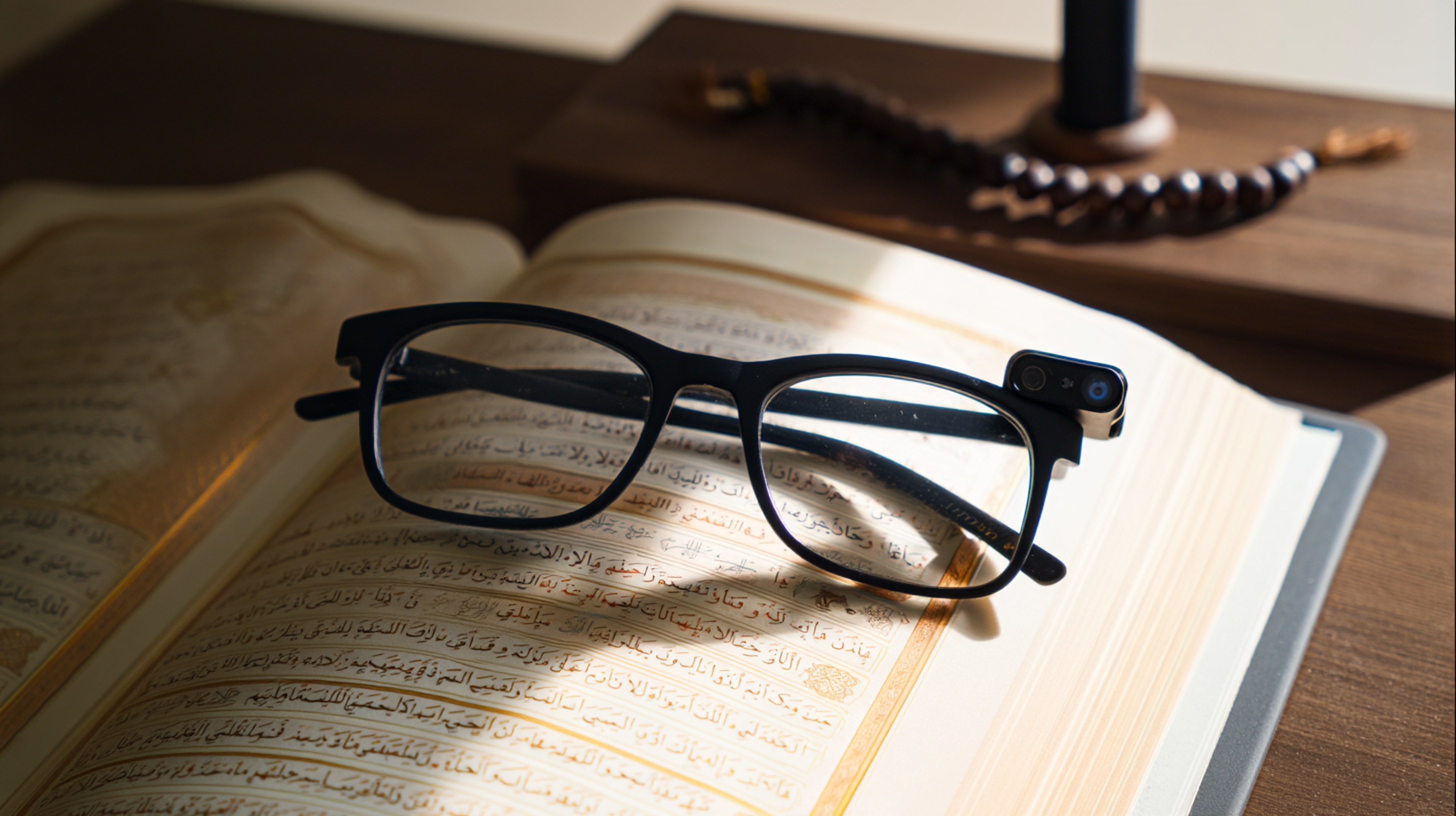
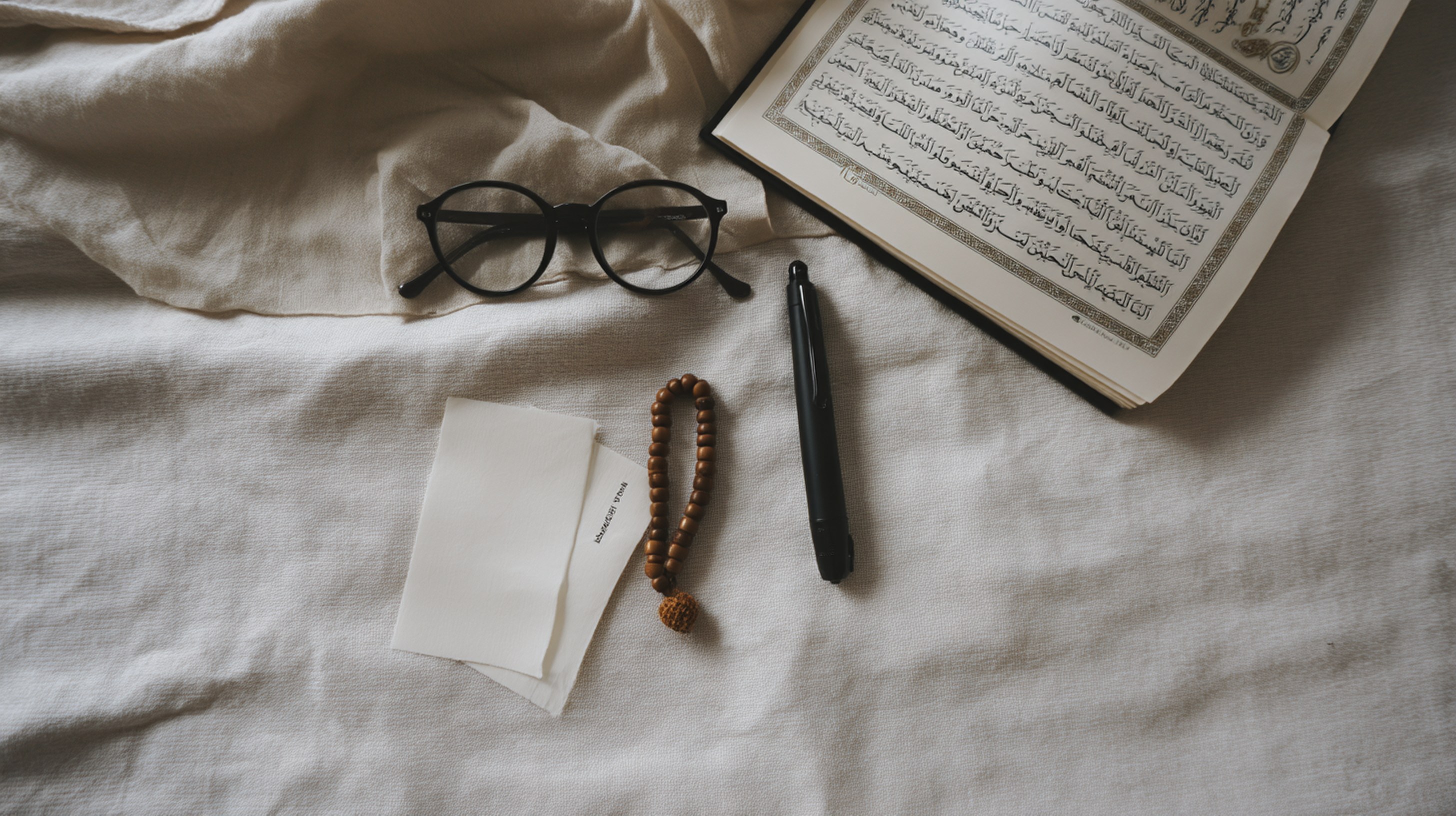
Silent Quran Reading
- Open Quran (any publisher, any typeface)
- Put on glasses (or clip-on to own prescription glasses)
- Place pen on line → LED glows green
- Slide across the line
- 1× click → Recitation via bone conduction
- 2× click → Translation as AR overlay
- 3× click → Word-by-word breakdown
- Glasses comfortable for 30+ minutes (under 40g)
- Pen lightweight like a ballpoint (under 20g)
- Bone conduction: family not disturbed, ear stays free for Azan
- Text recognition in under 1 second
Prayer (Salah) — Live Guide
- Put on glasses → Prayer mode (double-click temple arm or automatic)
- Qiyam: Glasses show "Allahu Akbar" + transliteration + meaning
- Ruku: "SubhanaRabbiyal Azim × 3" with counter
- Sujud: "SubhanaRabbiyal A'la × 3"
- Tashahhud: Full text At-Tahiyyatu
- After each rakat → next sequence automatically
- Motion sensor detects body position (gyroscope/accelerometer)
- NO pen needed — hands are occupied during prayer
- No sound in prayer mode (visual only) — respect for others praying
- Counter for repetitions (3× Tasbeeh)
Memorization (Hifz)
- Pen rests on the page (marks starting point)
- Learning phase: 3× click → word-by-word with repetition
- Test phase: Close eyes, recite from memory
- Glasses LISTEN (microphone) and compare with text
- On error → pen vibrates + correct word is whispered
- "I'm stuck" → 1× click → whisper next word
- Nobody else notices — silent help
- Microphone in glasses for speech recognition
- Vibration in pen for silent error feedback
- Spaced repetition algorithm
- Progress export for Hifz teachers
Father Teaches Child
- Father marks word → speaker plays audio (not bone conduction)
- Child repeats the word
- Father clicks forward → next word
- Child earns stars for correct repetitions
- Speaker mode (switchable from bone conduction)
- Multi-device pairing: 2 pens with 1 system
- Child mode: larger text, gamification, slower pace
Madrasa (1 Teacher → Many Students)
- Broadcast mode: Teacher marks → ALL glasses show the same text
- Student glasses: display + BLE receiver only → EUR 15-20 unit cost
- Teacher dashboard: sees who keeps up, who falls behind
- Opens the institutional market
Hajj / Umrah — AR Guide
- GPS-based station detection (Tawaf, Sa'i, Arafat)
- Tawaf counter via motion sensor (round 3/7)
- Station-specific duas pre-installed
- Heat resistant, extra battery, OFFLINE (no signal in crowds)
Technical Reality: How Does Recognition Work?
LED on the pen = user feedback only, NOT the recognition signal. The pen sends its position via Bluetooth (BLE). The glasses camera recognizes Arabic text optically (OCR). The LED only shows the user "I'm marking here" — it is not critical for functionality.
Problem in direct sunlight (Africa, 45°C+): The AR display (green overlay) is barely visible above 10,000 Lux. MicroLED displays have limitations in bright daylight. Solution: Audio mode. Instead of showing the translation visually, bone conduction/speaker whispers the meaning. Works always, regardless of lighting conditions.
Camera OCR works in sunlight too — like a phone camera. Modern computer vision (ViT models) can recognize Arabic text even in challenging lighting. Adaptive exposure + contrast normalization are standard.
- Audio mode as equal fallback — not just for visually impaired, but for ALL outdoor scenarios
- LED brightness adjustable (low indoors, high outdoors) or fully disableable
- AR display with high-brightness mode (like phone screen in sun)
- Pocket Device in Off-Grid Kit: audio-only mode as default, visual optional

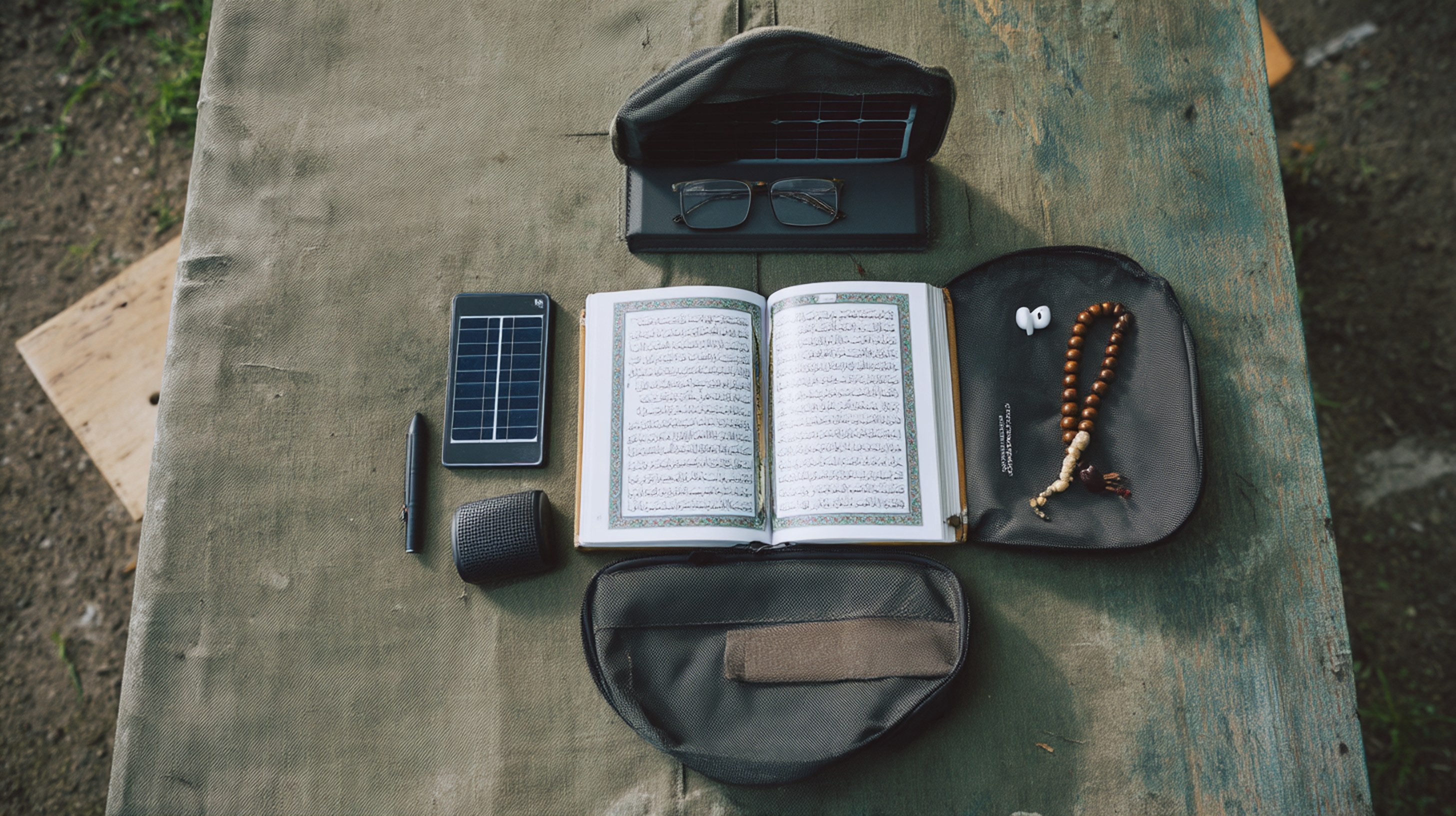
Village Without Infrastructure
Without glasses camera — how does the system recognize text?
- IP54+ (dust/water resistant)
- 12+ hours battery (full day)
- Speaker loud enough for outdoor groups
- 3-button operation (no touchscreen needed)
- No literacy prerequisite — purely audio-based
| Mode | Pen | Glasses | Description | |
|---|---|---|---|---|
| Recitation | 1× click | Display + Audio | Audio | Hear the verse recited |
| Translation | 2× click | AR Overlay | Text + Audio | See/hear the meaning |
| Word-by-Word | 3× click | Breakdown | Breakdown | Each word individually |
| Hifz | Rests on page | Listens | Tracks errors | Memorize with silent help |
| Prayer | — | Prayer text | — | Automatic position detection |
| Hajj | — | AR Guide + GPS | — | Station-based guidance |
| Teaching | Teacher pen | Broadcast | Dashboard | 1 teacher → many students |
| Off-Grid | Marks | — | Camera + Audio | No glasses, no phone |
| Child | Marks | Optional | Gamification | Stars, sounds, simple |
Smart Pen
Smart Glasses — The Brain
Simple clip-on design, no futuristic sci-fi glasses. Comparable to affordable Chinese AR clips (Rokid/Xreal level), but simpler: only 1 prism display + camera + BLE. Must fit any prescription glasses. Robust polycarbonate, not fragile.
Pocket Device
Foldable Solar Panel — Off-Grid Power
Charges Pocket Device + Pen simultaneously. 3 hours of sun = full day of operation. Designed for regions without power outlets.
  ┌────────────────┐     BLE 5.0      ┌──────────────────────────┐
  │   SMART PEN    │ ──────────────── │     SMART GLASSES        │
  │                │  Button Events   │                          │
  │  nRF52832      │  Position Data   │  ESP32-S3 (The Brain)    │
  │  LED + Vibrate │ ◄────────────── │  Camera → OCR → Matching │
  │  1 Button      │  Feedback Cmds   │  Display ← Translation   │
  │  200mAh        │                  │  Audio ← Recitation      │
  └────────────────┘                  │  IMU → Prayer Detection  │
                                      │  Mic → Hifz Listening    │
                                      └────────┬─────────────────┘
                                               │ BLE / WiFi
                                      ┌────────┴─────────────────┐
                                      │    APP (Phone) OR        │
                                      │    POCKET DEVICE         │
                                      │                          │
                                      │  Quran DB (6,236 Ayahs)  │
                                      │  40+ Translations        │
                                      │  20+ Reciters (Audio)    │
                                      │  Hifz Progress Tracking  │
                                      │  Spaced Repetition       │
                                      └──────────────────────────┘
BLE Communication Protocol
Power Budget — Battery Life Calculation
| Device | Capacity | Consumption (active) | Consumption (idle) | Runtime |
|---|---|---|---|---|
| Pen | 200mAh | ~15mA (BLE + LED) | ~0.1mA (Deep Sleep) | 12+ hours active |
| Glasses | 400mAh | ~90mA (camera+OCR+display+audio) | ~5mA (BLE standby) | 4+ hours active |
| 2000mAh | ~120mA (speaker+camera+processing) | ~2mA (E-Ink + sleep) | 14+ hours active |
- Camera on demand: Stream starts when pen button pressed, stops after 3s inactivity
- ESP32-S3 light sleep: ~5mA between OCR requests (instead of ~90mA at full load)
- Display off by default: MicroLED only active when result is shown (auto-off after 10s)
- USB-C fast charging: Pen in 30min, glasses in 45min, pocket in 2h
| Component | Specification | Unit Price |
|---|---|---|
| SMART PEN | ||
| MCU | nRF52832 BLE SoC (Nordic Semi) | €1.50 |
| LED | Green SMD LED (0603) | €0.10 |
| Button | Taktiler Schalter (Omron B3U) | €0.05 |
| Vibration | LRA vibration motor (Jinlong) | €0.30 |
| Battery | 200mAh LiPo + protection circuit | €0.80 |
| USB-C | Charging port + ESD protection | €0.20 |
| PCB | 2-Layer, 60×8mm | €0.40 |
| Enclosure | CNC Anodized Aluminium | €2.50 |
| Assembly + QC | SMT + THT + Functional test | €1.50 |
| Pen Total | €7.35 | |
| SMART GLASSES | ||
| MCU | ESP32-S3 (Espressif, 16MB Flash) | €3.00 |
| Camera | OmniVision OV5640 5MP AF | €2.50 |
| Display | MicroLED Modul (gruenes Overlay) | €4.00 |
| Audio | Bone conduction transducer | €2.50 |
| IMU | MPU6050 (Gyro + Accelerometer) | €0.80 |
| Microphone | MEMS (InvenSense ICS-43434) | €0.40 |
| Battery | 400mAh LiPo (temple-integrated) | €1.00 |
| Antenna + PCB | Flex-PCB + BLE ceramic antenna | €1.00 |
| Enclosure | Polycarbonate frame + Clip-On | €2.00 |
| Assembly + QC | SMT + Optics calibration | €2.00 |
| Glasses Total | €19.20 | |
| POCKET DEVICE | ||
| MCU | ESP32-S3 (16MB Flash, 8MB PSRAM) | €3.00 |
| Display | E-Ink 2.13" (Waveshare-kompatibel) | €3.00 |
| Speaker | 2W Class-D Amp + Speaker | €0.80 |
| Camera | OV2640 2MP (Off-Grid Version) | €1.50 |
| Battery | 2000mAh LiPo + BMS | €2.00 |
| Storage | 8GB eMMC Flash | €1.50 |
| Charge IC | USB-C + Solar input (TP4056) | €0.80 |
| Enclosure | ABS IP54 (Injection mold) | €1.50 |
| Assembly + QC | SMT + seal test | €1.50 |
| Pocket Total | €15.60 | |
| SOLAR PANEL | ||
| Cells | 5V/5W Monokristallin (faltbar) | €3.50 |
| Controller | Charge IC (TP4056 + MPPT) | €0.30 |
| Output | USB-A Buchse | €0.20 |
| Enclosure | Nylon folding case | €1.50 |
| Cable + Assembly | USB-C cable + packaging | €0.80 |
| Solar Total | €6.30 | |
Note: Margins before Sadaqah (20% of RRP), marketing, end-customer shipping, and platform fees. Real net margin after all deductions: ~40-50%. At 50K+ units, BOM costs decrease ~15-20% through volume discounts.
Week 1-4: Proof of Concept
- Order ESP32-S3 DevKit + OmniVision camera module (~€30)
- Train Arabic OCR model (Hugging Face ViT, 30+ typefaces)
- Establish BLE connection between ESP32 and smartphone
- Result: Camera recognizes Arabic text → shows translation on phone
Week 5-8: Hardware Integration
- 3D-printed glasses enclosure (Shapeways/local printer)
- Install camera + ESP32 + BLE in glasses enclosure
- Pen: Arduino Nano BLE + LED + button in pen housing
- NUR App: implement BLE pairing + live camera feed
- Result: Pen marks → glasses recognize → app shows result
Week 9-12: User Testing
- Build 5-10 prototypes for testers in Munich/Berlin
- Testers: converts, families, Hifz students
- Collect feedback: What works? What doesn't?
- Improve OCR model with real-world data
- Result: Validated prototype + user feedback for Phase 2
Estimated cost for 10 prototypes: ~€3,000-5,000 (components + 3D printing + shipping). No investor needed — bootstrappable from e-commerce revenue.
| Region | Muslims | Package Focus | Channel | Priority |
|---|---|---|---|---|
| DACH | 5.5M | Essentials + Independence | Moscheen, Amazon.de, Shopify | Phase 1 |
| UK | 4M | Essentials + Independence | Amazon UK, Islamic bookstores | Phase 1 |
| Turkey | 84M | Essentials (affordable) | Local partners, Hepsiburada | Phase 2 |
| Indonesien | 242M | Essentials + Impact | Tokopedia, Lazada, NGOs | Phase 2 |
| South Asia | 600M+ | Essentials + Off-Grid | Flipkart, Daraz, Madaris | Phase 3 |
| Sub-Saharan Africa | 250M+ | Impact (Sadaqah) | NGOs, Islamic Relief | Phase 3 |
| MENA | 300M+ | Premium + Hajj | Noon.com, local retailers | Phase 3 |
| USA/Kanada | 4M | Independence + Off-Grid | Amazon.com, ISNA, MSA | Phase 2 |
The Quran is at the center, not the technology. The tech is invisible. The person interacts with their book, not with a gadget.
Fewer clicks = better. Maximum 3 interactions for any function. A child must understand it in 2 minutes.
Respect for the sacred text. No gamification with Quran verses. No ads. No distractions.
Offline first. Every core function works without internet. Internet is a bonus, not a requirement.
Robust over elegant. The Impact Kit survives drops. The Solar Kit works at 45°C. Dust resistant.
Privacy by Design. No cloud requirement. No tracking. No accounts needed.
NUR App — 290+ Screens
The app is the software core of the ecosystem. All modes (recitation, translation, word-by-word, Hifz) are implemented. What's missing: hardware integration (BLE pairing with pen/glasses).
NUR
Product Design Specification · Munich · 2026